
Warren County Projected Release Dates
A projected date is a calculation or eligibility marker, not a completed release. Tennessee’s Felony Offender Information Lookup does not use a field literally titled “Projected Release Date.” It displays Sentence End Date and Release Eligibility Date. Sentence End Date is the closer match to a computed sentence endpoint. Release Eligibility Date marks when parole consideration may become possible under the sentence. Neither one proves that a person walked out on that day.
Actual release is an executed custody event. The responsible jail or TDOC record should state the time, method, and destination. A state prisoner may instead leave one site for a county detainer, another correctional facility, or a different agency. A Warren County Jail exit can likewise be a transfer into TDOC custody. Date language must stay tied to the agency and stage it describes.
A pretrial detainee does not yet have a sentence endpoint. Bond, dismissal, a plea, trial, a court order, or transfer can determine the next step. The Warren County General Sessions Court handles misdemeanor and preliminary felony matters, while the jail records the physical custody movement. A calendar setting alone is not the release.
Find Warren County State Release Dates
For a state felony sentence, start with the Tennessee Department of Correction FOIL search. FOIL covers felony offenders currently or formerly in TDOC custody or under TDOC supervision. Search by TDOC ID or State ID Number when either is known. A name search permits first and last name, race, and an alias option, followed by a case-sensitive visual or audio challenge.
The detail must be read as a set. Match the person by identity and photograph when present. Then note Current Status, Assigned Location, combined sentence, sentence begin date, Sentence End Date, Release Eligibility Date, active Tennessee sentences, Parole Hearing Date, and Parole Hearing Result. “Incarcerated” means the person has not left TDOC custody even if Assigned Location names a county jail. “Parole” indicates release from incarceration into supervised status. “Inactive” needs date and sentence context before it can support discharge.
- Search FOIL with a TDOC ID, SID, or carefully checked name and alias.
- Match the detail by photograph and identity fields before recording any date.
- Read Current Status and Assigned Location before interpreting sentence fields.
- Record Sentence End Date and Release Eligibility Date by those exact names.
- Check active sentences, sentence structure, and hearing fields for other constraints.
- Use the judgment and offender record to resolve the governing offense date and eligibility rule.
- Request the sentence computation when a displayed date is disputed or changes.
FOIL warns that court records received later can change displayed dates. Save the check date with the result, and never substitute a hand calculation for the correctional record. The full Warren County named-person search and jail release-record path is available from the released-inmates home page.
Warren County Jail Release Computation
A locally served county sentence may never appear in FOIL. The Warren County Sheriff’s Department controls the jail movement and applicable local credit record, while the Circuit Court Clerk controls the judgment and later court orders. Call Jail Info & Records at 931-473-7863 for the scheduled and actual movement. Ask the clerk for the judgment or modifying order when the date depends on a court action.
This phone-first channel is essential because the official sheriff page publishes no projected-date calculator, county good-time formula, release-processing schedule, weekend practice, or roster archive. Do not borrow another Tennessee jail’s practice. If an expected date falls on a weekend or holiday, ask the jail rather than assuming early or delayed release. Warren County’s local rules place motions for early release on a calendar with probation violations, but the calendar only locates the hearing. The signed order and executed jail movement establish the result.
Felony time credited while a person is physically in a county jail can still affect a TDOC calculation. Public Chapter 427, effective July 1, 2023, requires a jail administrator to report applicable good-institutional-behavior sentence-reduction credits to TDOC. A corrected local report can move the state date. That does not turn the sheriff’s web page into a state sentence calculator.
Note: Warren County publishes no official weekend-release rule, so confirm any locally served sentence date with both the jail and clerk.
Warren County Release Eligibility Rules
Tennessee computation is person-specific. Tenn. Code Ann. § 40-35-501 is the core release-eligibility statute, and § 41-21-236 governs sentence-reduction credits. Offense date, conviction, offender range, imposed sentence, concurrent or consecutive terms, pretrial credit, discipline, and exclusions all matter. The judgment must be read with the current statute.
Public Chapter 988 created truth-in-sentencing rules for listed offenses committed on or after July 1, 2022. One group must serve 100 percent without a reduction from sentence credits. A second group is stated at 100 percent but may apply earned credits toward eligibility after serving at least 85 percent, for no more than a 15 percent reduction. “Serve 85 percent” is not a rule for every Tennessee prisoner or all violent offenses.
Other sentences can carry formal release-eligibility percentages such as 20, 30, 35, 45, 60, 75, 85, or 100 percent. Those numbers are legal categories set by the sentence and offense law, not menu choices or estimates. Applying a newer rule to an older offense without checking effective dates can create a false release date.
The official Public Chapter 988 bill history documents the enacted measure and source trail.
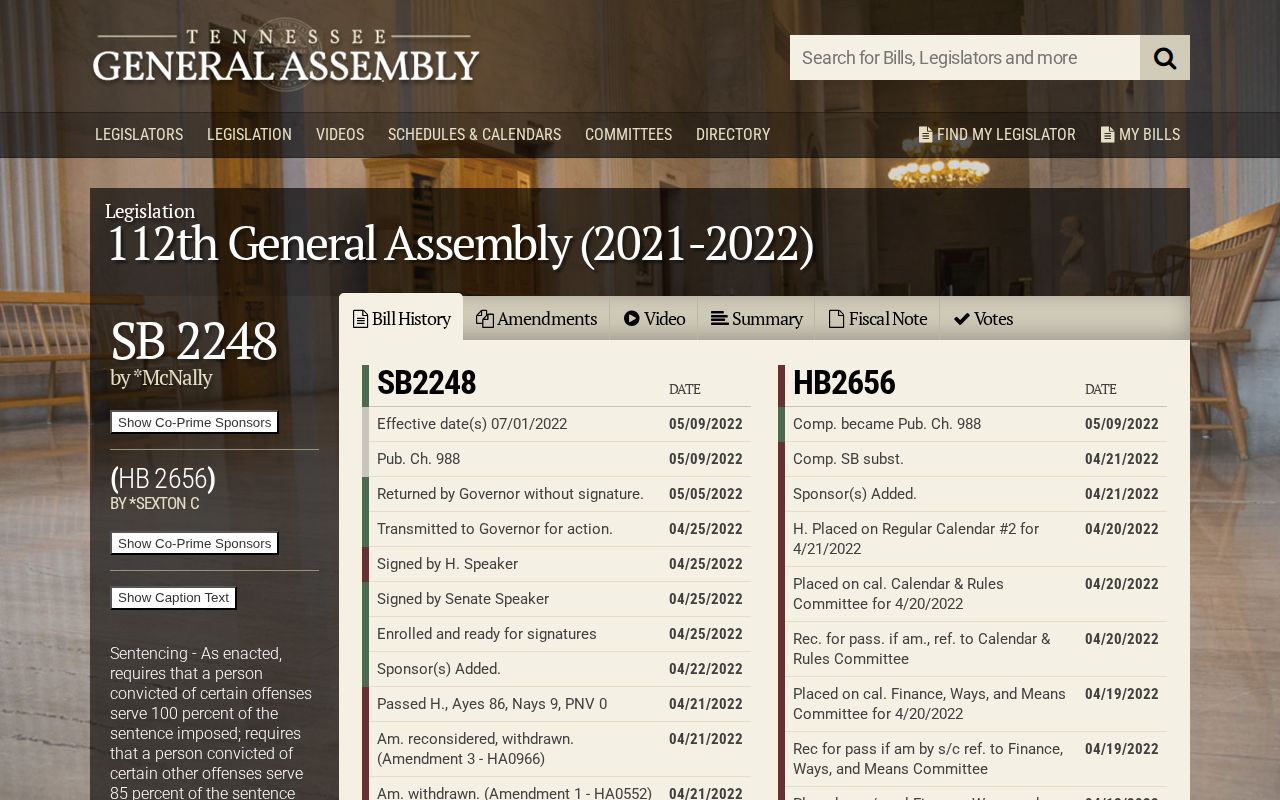
The bill record supplies the law’s history. A person’s judgment and offense date still determine whether its provisions govern that sentence.
Warren County Sentence Credit Effects
TDOC’s offender handbook describes credits as a privilege for eligible prisoners. It lists four behavior-credit days per month during the first calendar year and six after the first year. Eligible full-time program work can add up to six program days per month. The handbook also describes minimum-custody bonuses and certain one-time 60-day education or treatment credits. Statutory restrictions and individual eligibility can limit or bar those credits.
Discipline can withhold or remove earned credit. TDOC policy states that credit loss can extend Release Eligibility Date. In the other direction, corrected jail credit, a later court document, or earned eligible credit may move a displayed date forward. These are official computation inputs, not a simple number to subtract from the imposed sentence. When the web detail and judgment seem to conflict, request the TDOC sentence-computation record and supporting judgments.
Why Warren County Release Dates Change
A future date can move for reasons that have nothing to do with a data error. Some changes affect the legal computation. Others affect physical departure or destination while the sentence date stays the same. Read the updated status and source document before deciding what changed.
| Factor | Possible effect | Record to verify |
|---|---|---|
| Corrected judgment or jail credit | TDOC recomputes end or eligibility fields | Judgment, jail credit report, TDOC computation |
| Eligible behavior or program credit | May advance eligibility within statutory limits | TDOC credit record |
| Discipline or credit loss | May delay Release Eligibility Date | TDOC disciplinary and computation records |
| 85 or 100 percent rule | Caps or eliminates credit effect | Offense date, judgment, governing statute |
| Parole grant or denial | Changes the release path, but a grant still needs plan approval | Board final action and FOIL status |
| Detainer or receiving custody | Changes destination and may prevent community return | Release movement and receiving-agency record |
| Consecutive sentence or active case | Extends confinement beyond one isolated date | All judgments and active sentence fields |
| Mandatory reentry supervision | Creates supervised community status on a distinct legal path | FOIL, TDOC record, and § 40-35-506 |
A detainer is a request from another authority regarding custody or notice. It may cause one agency’s release to become another agency’s admission. Therefore, a Warren County or TDOC release date without a destination does not by itself show return to the community.
Warren County Parole Date Limits
FOIL may show Parole Hearing Date and Parole Hearing Result alongside release fields. These values answer different questions. Release Eligibility Date is the point when parole consideration may arise. Hearing Date shows when the Board process is set. A grant is a favorable decision, but physical release still depends on release-plan approval and required pre-parole steps. Current Status “Parole” is stronger evidence that incarceration ended for supervised community status.
The Tennessee Board of Parole posts weekly schedules, normally refreshed Monday or Tuesday after a Monday holiday. Changes may occur. No separate public name-based decision database was found beyond FOIL’s Parole Hearing Result field. If an individual result is unclear, request the final decision from the Board instead of estimating from an aggregate grant rate.
Board outcomes include grant, denial, continuation, revocation, reinstatement, and rescission depending on the hearing type. An appeal may address specified new information, misconduct, or significant procedural error, and the Board states that a request is due within 45 days after the person receives final-decision notice. An appeal or continued hearing can change the path without creating a firm exit date.
Note: A parole eligibility date, hearing date, and grant are three separate milestones, and none alone proves physical release.
Confirm Warren County Actual Release
Use the agency that executed the movement. Warren County Jail Info & Records can confirm the local exit time, release disposition, and destination. TDOC can confirm a state release movement, method, and sentence computation. The court can confirm the judgment, bond, dismissal, or order that authorized a local change. When the person went to another agency, continue in that receiving system rather than calling the first agency’s exit a community release.
VINE can send a future custody alert from a participating agency feed, but its event should be reconciled with the originating record. Registration and its limits are covered in the Warren County VINE inmate check. A failed search is not proof of release. Likewise, an alert labeled “released” identifies the feeding agency’s end of custody but may not state bond, sentence completion, parole, transfer, or detainer.
For a durable state record, use TDOC’s archived-record request and ask for sentence computation, actual release date and method, release movement, discharge, and supporting correction source. For a local term, request the jail release entry and the clerk’s final order. Preserve the date each dynamic source was checked. That creates a clear line from estimate to final event without turning a changing field into a promise.